| ||
| ||
|
Elevate-The-Soul Online Radio (Rick Tingling-Clemmons Interview on Racism Included)
Wednesday, May 27, 2009
Aluta Continua............ (The Struggle Continues)


Thursday, March 19, 2009
Black Like Me
The Deep South of the late 1950s was another country: a land of lynchings, segregated lunch counters, whites-only restrooms, and a color line etched in blood across Louisiana, Mississippi, Alabama, and Georgia. White journalist John Howard Griffin, working for the black-owned magazine Sepia, decided to cross that line. Using medication that darkened his skin to deep brown, he exchanged his privileged life as a Southern white man for the disenfranchised world of an unemployed black man.
What happened to John Howard Griffin - from the outside and within himself - as he made his way through the segregated Deep South is recorded in this searing work of nonfiction. Educated and soft-spoken, John Howard Griffin changed only the color of his skin. It was enough to make him hated... enough to nearly get him killed. His audacious, still chillingly relevant eyewitness history is a work about race and humanity every American must read.
John Griffin wrote this book in the early 60s and published it in 1962. He later wrote an epilogue on his thoughts, entitled: What's Happened since Black Like Me:
"The experiment that led to writing Black Like Me was done at the very end of 1959, before the first "freedom rides" or any other manifestation of national concern about racisl injustice. It was undertaken to discover if America was involved in the practice of racism against black Americans. Most white Americans denied any taint of racism and really believed that in this land we judged every man by his qualities as a human individual. In those days, any mention of racism brought to the public's mind the Nazi suppression of Jewish people, the concentration camps, the gas chambers - and certainly, we protested, we were not like that.
If we could not accept our somewhat different practice of racist suppression of black Americans, how could we ever hope to correct it? Our experience with the Nazis had shown one thing: where racism is practiced, it damages the whole community, not just the victim group....
Were we racists or were we not? That was the important thing to discover. Black men told me that the only way a white man could hope to understand anything about this reality was to wake up some morning in a black man's skin. I decided to try this in order to test this one thing. In order to make the test, I would alter my pigment and shave my head, but change nothing else... "
The Spook read this book nearly 40 years ago. Yet, racism at this same level exists in the Fire Department, the Police Department, the law firms, hospitals and in varied other DC institutions harbored by some white people even today. Racism, sexism and other negative 'isms' are mostly supported by a capitalist economic system that is based on exploitation and supported by its actions to divide and conquer on the basis of class, race and sex, to name a few areas. The Spook commends this book to your attention and reminds you, that To Change Things we must learn things; and to learn things we must change everything.
Sunday, March 8, 2009
Closing Out Black History Month '09 - Some Words from Malcolm X, compliments of the Spook
In recognition of Black History Month, the Spook will contribute an article by Malcolm X, one of the most misunderstood Americans in history. This, his writing of a history he witnessed (readings), is not an indictment of all European descendants now living in America, for we know there is only one race, the human race. Yet it is well documented the criminal way some Europeans have treated his brothers and sisters who are not European. It is this history recounted by Malcolm X that is featured here that should be read and learned to be better humans and family.
HOW MALCOLM X STUDIED AFRO-AMERICAN HISTORY
Norfolk Prison Colony’s library was one of its outstanding features. A millionaire named Parkhurst had willed his library there; he had probably been interested in the rehabilitation program. History and Religions were his special interests. Thousands of his books were on the shelves, and in the back were boxes and crates full, for which there wasn’t space on the shelves. At Norfolk, we could actually go into the library, with permission – walk up and down the shelves, pick books. There were hundreds of old volumes, some of them probably quite rare. I read aimlessly, until I learned to read selectively, with a purpose…*
I can remember accurately the very first set of books that really impressed me. I have since bought that set of books and have it at home for my children to read as they grow up. It’s called Wonders of the World. It’s full of pictures of archaeological finds, statues that depict, usually, non-European people.
I found books like Will Durant’s Story of Civilization. I read H.G. Wells’ Outline of History. Souls of Black Folk by W.E.B. Dubois gave me a glimpse into the black people’s history before they came to this country. Carter G. Woodson’s Negro History opened my eyes about black empires before the black slave was brought to the United States, and the early Negro struggles for freedom.
J.A. Rogers’ three volumes of Sex and Race told about race-mixing before Christ’s time; about Aesop being a black man who told fables; about Egypt’s Pharaohs; about the great Coptic Christian Empires; about Ethiopia, the earth’s oldest continuous black civilization, as China is the oldest continuous civilization.
I never will forget how shocked I was when I began reading about slavery’s total horror. It made such an impact upon me that it later became one of my favorite subjects when I became a minister of Mr. Muhammad’s. The world’s most monstrous crime, the sin and the blood on the white man’s hands, are almost impossible to believe. Books like the one by Frederick Olmstead opened my eyes to the horrors offered when the slave was landed in the United States. The European woman Fannie Kimball [Kemble], who had married a Southern white slaveowner, described how human beings were degraded. Of course I read Uncle Tom’s Cabin. In fact, I believe that’s the only novel I have ever read since I started serious reading.
Parkhurst’s collection also contained some bound pamphlets of the Abolitionist Anti-Slavery Society of New England. I read descriptions of atrocities; saw those illustrations of black slave women tied up and flogged with whips; of black mothers watching their babies being dragged off, never to be seen by their mothers again; of dogs after slaves, and of the fugitive slave catchers, evil white men with whips and clubs and chains and guns. I read about the slave preacher Nat Turner, who put the fear of God into the white slave-master. Nat Turner wasn’t going around preaching pie-in-the-sky and “non-violent” freedom for the black man. There is Virginia one night in 1831, Nat and seven other slaves started out at his master’s home and through the night they went from one plantation” big house” to the next, killing, until by the next morning 57 white people were dead and Nat had about 70 slaves following him. White people, terrified for their lives, fled from their homes, locked themselves up in public buildings, hid in the woods, and some even left the state. A small army of soldiers took two months to catch and hang Nat Turner. Somewhere I have read where Nat Turner’s example is said to have inspired john Brown to invade Virginia and attack Harper’s Ferry nearly thirty years later, with thirteen white men and five Negroes…
Book after book showed me how the white man had brought upon the world’s black, brown, red and yellow peoples every variety of the sufferings of exploitation. I saw how since the sixteenth century, the so-called “Christian trader” white man began to ply the seas in his lust for Asian and African empires, and plunder, and power. I read, I saw, how the white man never has gone among the non-white peoples bearing the Cross in the true manger and spirit of Christ’s teachings – meek, humble, and Christlike.
I perceived, as I read, how the collective white man had been actually nothing but a piratical opportunist who used Faustian machinations to make his own Christianity his initial wedge in criminal conquests. First, always “religiously,” he branded “heathen” and “pagan” labels upon ancient non-white cultures and civilizations. The stage thus set, he then turned upon his non-white victims his weapons of war…
Over 115 million African blacks – close to the 1930’s population of the United States – were murdered or enslaved during the slave trade. And I read how when the slave market was glutted, the cannibalistic white powers of Europe next carved up, as their colonies, the richest areas of the black continent. And Europe’s chancelleries for the next century played a chess game of naked exploitation and power from Cape Horn to Cairo …*
I’ll tell you something. The whole stream of Western philosophy has now wound up in a cul-de-sac. The white man has perpetrated upon himself, as well as upon the black man, so gigantic a fraud that he has put himself into a crack. He did it through his elaborate, neurotic necessity to hide the black man’s true role in history.
And today the white man is faced head on with what is happening on the Black Continent, Africa. Look at the artifacts being discovered there, that are proving over and over again, how the black man had great, fine, sensitive civilizations before the white man was out of the caves. Below the Sahara, in the places where most of America’s Negroes’ foreparents were kidnapped, there is being unearthed some of the finest craftsmanship, sculpture and other objects, that has ever been seen by modern man. Some of these things now are on view in such places as New York City’s Museum of Modern Art. Gold work of such fine tolerance and workmanship that it has no rival. Ancient objects produced by black hands. . . refined by those black hands with results that no human hand today can equal.
History has been so “whitened” by the white man that even the black professors have known little more than the most ignorant black man about the talents and rich civilizations and cultures of the black man of millenniums ago. I have lectured in Negro colleges and some of these brainwashed black Ph.D.’s, with their suspenders dragging the ground with degrees have run to the white man’s newspapers calling me a “black fanatic.” Why, a lot of them are fifty years behind the times. If I were president of one of these black colleges..I’d hock the campus if I had to, to send a bunch of black students off digging in Africa for more and more proof of the black race’s historical greatness. The white man now is in Africa digging and searching. An African elephant can’t stumble without falling on some white man with a shovel. Practically every week, we read about some great new find from Africa’s lost civilizations. All that’s new is white science’s attitude. The ancient civilizations of the black man have been buried on the Black Continent all the time.
Here is an example: a British anthropologist named Dr. Louis S.B. Leakey is displaying some fossil bones – a foot, part of a hand, some jaws, and skull fragments. On the basis of these, Dr. Leakey has said it’s time to rewrite completely the history of man’s origin.
This species of man lived 1,828,036 years before Christ. And these bones were found in Tanganyika [now Tanzania] . In the Black Continent.
It’s a crime, the lie that has been told to generations of black men and white men both. Little innocent black children, born of parents who believed that their race had no history. Little black children seeing, before they could talk, that their parents considered themselves inferior. Innocent black children growing up, living out their lives, dying of old age – and all of their lives ashamed of being black. But the truth is pouring out of the bag now….*
In the words of Harold Melvin and the Bluenotes, "Wake up everybody! We need some help y'all. Remember, the world won't get no better if we just let it be; we've got to change it, just you and me.
Sunday, February 22, 2009
Man Died of Heart Attack; Family Plans Suit
 Relatives said Edward Givens died after paramedics told him acid reflux caused his chest pains. (Courtesy Of Lolitha Givens) |

Saturday, February 21, 2009; Page B08
The medical examiner has determined that a heart attack was the cause of death for a 39-year-old Northeast Washington man whose family said paramedics told him he had acid reflux and did not take him to a hospital when he complained of chest pains and trouble breathing.
An attorney for the family said yesterday it is preparing to sue the city for "individual acts of negligence" and "systemic errors" in providing emergency medical care.
"If the fire department had transported him to the hospital when he first called, he would be alive today," said William Lightfoot, representing the family of Edward L. Givens.
The District settled a multimillion-dollar lawsuit over missteps in emergency medical services two years ago, promising the family of retired New York Times journalist David E. Rosenbaum that it would make operational reforms. Mayor Adrian M. Fenty (D) appointed a task force, and the city's fire chief said he has been implementing its recommendations.
Givens was not breathing when a relative found him lying in a hallway early on the morning of Dec. 3.
Six hours earlier, paramedics who had responded to a 911 call at the family home had said Givens's vital signs were normal and told him to take an antacid for indigestion, family members said.
Beverly Fields, chief of staff for the D.C. office of the chief medical examiner, said in an e-mail that an autopsy found that Givens died from "occlusive coronary atherosclerosis due to arteriosclerotic cardiovascular disease." In layman's terms, Givens had heart disease, and his arteries became so clogged that the disruption to blood flow was fatal. Chest discomfort and shortness of breath are typical warning signs of a heart attack.
D.C. Fire Chief Dennis L. Rubin has asked the city's inspector general to investigate the agency's actions in regard to Givens, and D.C. Attorney General Peter J. Nickles said the city would conduct an operational review of the matter.
A fire department spokesman said yesterday that he had not seen the coroner's report and referred all requests for comment to Nickles.
Nickles said he has reviewed a draft of the operational report on the Givens case but said a final version will not be completed until the medical examiner's office concludes its evaluation. He also said he was unaware that the medical examiner had determined a cause of death.
He would not comment yesterday on the operational report but said, "The city gets sued all the time."
"Bill's a good lawyer, and I look forward to seeing him in court," Nickles added.
An spokesman for the inspector general said he could not comment because the probe is ongoing.
Lolitha Givens said she has not been contacted by city officials about her son's death.
She said that her family has a history of heart disease and that she had a heart attack in 1994. "Maybe his death could not have been avoided [but] it might not have been as swift," she said, fighting back tears.
Every day since her son's death, she has questioned her decision to listen to the paramedics, she said. She said that an electrocardiogram was performed and that the paramedics said it was normal. "They convinced us his vital signs were good . . . so who were we to second-guess them?" she said.
Terry Jodrie, a regional medical director for the state agency that oversees emergency medical services in Maryland, said that not all heart attack victims will show an abnormal electrocardiogram and that heartburn can have the same symptoms. "This is one of the things that makes the diagnosis so difficult," Jodrie said.
Paul Maniscalco, a senior researcher at George Washington University and a past president of the National Association of Emergency Medical Technicians, said paramedics should always err on the side of safety. "By transporting to the hospital, you bring the patient the benefit of a higher medical and clinical competence," he said.
Lightfoot said the Givens family, like the Rosenbaums, hopes legal action will spur the city to improve its emergency medical care.
"Mr. Givens' death was preventable, and Mr. Rosenbaum's death was preventable, and our goal is to see that there are no more needless deaths," Lightfoot said yesterday.
Saturday, February 14, 2009
Black History Month: Imagine If There Were No Black People in the World
Son Güncelleme:
By Makebra Anderson
One morning, a little boy named Theo woke up and asked his mother, "Mom, what if there were no Black people in the world?"
His mother thought about that for a moment, and then said, "Son, follow me around today and lets just see what it would be like if there were no Black people in the world. Now go get dressed and we will get started.”
Theo ran to his room to put on his clothes and shoes. His mother took one look at him and said, "Theo, where are your shoes? Son, I must iron your clothes. Why are they so wrinkled?
When she reached for the ironing board it was no longer there. You see, Sarah Boone, a Black woman, invented the ironing board and Jan E. Matzelinger, a Black man, invented the shoe lasting machine. The shoe lasting machine is a machine that attaches the top of the shoe to the sole.
"Oh well," she said, "Please go and do something to your hair." Theo ran in his room to comb his hair, but the comb was not there."
You see, Walter Sammons, a Black man, invented the comb.
Theo decided to just brush his hair, but the brush was gone. Lydia O. Newman, a Black female, invented the brush.
Well, this was a sight. Theo had no shoes, wrinkled clothes, and his hair was a mess. Even his mom's hair was a mess. See Madam C. J. Walker was one of the first African-American female entrepreneurs, and she created many hair care products for Black women.
Mom told Theo, "Let's do our chores around the house, and then take a trip to the grocery store."
Theo's job was to sweep the floor. He swept and swept and swept. When he reached for the dustpan, it was not there. You see, Lloyd P. Ray, a Black man, invented the dustpan.
So he swept his pile of dirt over in the corner and left it there. He then decided to mop the floor, but the mop was gone. You see, Thomas W. Stewart, a Black man, invented the mop.
Theo yelled to his Mom, "Mom, I'm not having any luck!”
"Well son," she said, "Let me finish washing these clothes and we will prepare a list for the grocery store."
When the wash finished, she went to place the clothes in the dryer, but it was not there. You see, George T. Sampson, a Black man, invented the clothes dryer.
Mom asked Theo to get a pencil and some paper to prepare their list for the market. So Theo ran for the paper and pencil but noticed that the pencil lead was broken. Well, he was out of luck because John Love, a Black man, invented the pencil sharpener.
Mom reached for a pen, but it was not there because William Purvis, a Black man, invented the fountain pen. As a matter of fact, Lee Burridge another Black man, invented the typewriting machine, and W. A. Lovette, another Black man, the advanced printing press.
Theo and his mother decided to head to the market. Well, when Theo opened the door he noticed the grass was almost 5 feet tall. You see, the lawn mower was invented by John Burr, a Black man.
They made their way over to the car and found that it just wouldn't go. You see, Richard Spikes, a Black man, invented the automatic gearshift and Joseph Gammel invented the supercharge system for internal combustion engines. Without these, the car wouldn’t work. Gammel was also a Black man.
They noticed that the few cars that were moving were running into each other and having wrecks because there were no traffic signals. You see, Garrett A. Morgan, a Black man invented the traffic light.
Well, it was getting late, so they walked to the market, got their groceries and returned home. Just when they were about to put away the milk, eggs and butter, they noticed the refrigerator was gone. You see John Standard, a Black man, invented the refrigerator. So they just left the food on the counter.
By this time, Theo noticed he was getting mighty cold. Mom went to turn up the heat; however, Alice Parker, a Black female, invented the heating furnace so they didn't have heat. Even in the summer time they would have been out of luck because Frederick Jones, a Black man, invented the air conditioner.
It was almost time for Theo's father to arrive home. He usually took the bus. But there was no bus. Buses came from electric trolleys, which were invented by another Black man, Elbert R. Robinson. He usually took the elevator from his office on the 20th floor, but there was no elevator because Alexander Miles, a Black man, invented the elevator.
He also usually dropped off the office mail at a near by mailbox, but it was no longer there because Philip Downing, a Black man, invented the letter drop mailbox and William Barry, another Black man, invented the postmarking and canceling machine which, which is how we get stamps.
Theo and his mother sat at the kitchen table with their head in their hands. When the father arrived he asked, "Why are you sitting in the dark?" Why? Because Lewis Howard Latimer, a Black man, invented the filament within the light bulb. Without a filament a light bulb won’t turn on.
Theo quickly learned what it would be like if there were no Black people in the world. Daily life would be a lot more difficult, not to mention if he were ever sick and needed blood. Charles Drew, a Black scientist, found a way to preserve and store blood, which led to his starting the world's first blood bank.
And, what if a family member had to have heart surgery? This would not have been possible without Dr. Daniel Hale Williams, a Black doctor, who performed the first open heart surgery.
You don't have to wonder, like Theo, what the world would be like without African-Americans. It’s clear, life as we know it would be very different!
This February, celebrate the contributions of African-Americans by participating in cultural festivals, going to the African-American history museum in your neighborhood, or learning more about Black inventors.
Saturday, December 13, 2008
Walking for Freedom, The Montgomery Boycott (continued)
Getting Ready to Boycott - Chapter 3
Mrs. Robinson knew just what to do. As soon as she heard about Mrs. Parks, she called the Women's Political Council. She told them what had happened. They all agreed that this was the moment they had been waiting for. It wsa time to boycott the Montgomery buses. Mr. Nixon and other leaders liked the idea, too.
Mrs. Robinson got busy quickly. The very evening of the day Mrs. Parks was arrested, Mrs. Robinson went to her college. She wrote a leaflet telling people about the boycott.
"If we do not do something to stop these arrests, they will continue," she wrote. "We are asking every Negro to stay off the buses Monday in protest of the arrest and trial. Don't ride the buses to work, to town, school, or anywhere on Monday."
She stayed up all night making thousands of copies of the leaflet. The next morning, students helped her take the leaflets to black homes and businesses all over Montgomery. By Friday afternoon, December 2, many black people knew about the boycott.
Mr. Nixon was busy, too. He phoned the community leaders and the ministers or the black leaders. "We need to plan how we'll carry out the boycott," he told them. He asked them to meet at the Dexter Avenue Baptist Church that evening.
Mr. Nixon also wanted to make sure that everybody knew about the boycott. He was even willing to risk letting whites know about it. So he called Joe Azbell editor of the Montgomery Advertiser. "I've got a big story for you and I want you to meet me," he said.
Mr. Azbell met him at the railroad station. Wearing a porter's jacket and black cap. Mr. Nixon showed the editor one of Mrs. Robinson's leaflets. We're gonna boycott these buses," he said.
"We're tired of them fooling with our women - they done if for the last time." Nixon's voice was angry and sharp. But he wasn't mad at Azbell. He was mad at the Montgomery law, the bus drivers, and the mayor.
"You're gonna put this on the front page?" he asked the editor.
"Yeah, I'm gonna try to," Mr. Azbell replied.
Pleased with his meeting, Mr. Nixon waved goodbye to Mr. Azbell. A front page news story would make sure everyone knew about the boycott. Then he got on a train headed for Atlanta, Georgia. He had to work that night and would not be able to go to the meeting at the Dexter Avenue Baptist Church.
Meanhwhile, at the college, Mrs. Robinson got a note from her boss, Dr. renholm. He waterd to see her right away. When she entered his office, sha saw that he was angry. His lips were pressed tightly together, and his eyes were squinting. He looked at Mrs. Robinson. Then he help up one of the leaflets she'd written.
"What is this all about?" he asked shaply. "And what do you have to do with it?"
Mrs. Robinson was surprised and a little frightened. SHe stammered a little and explained what had happened to Mrs. Parks. :Other people have been arrested in the past. All they did was refuse to give up their seats to a white person," she said.
"Were there other seats?" Dr. Trenholm snapped. He knew that the law said that a black person had to give the seat to a white person only if there were no empty seat in the black section of the bus.
"No, there wasn't an empty seat," Mrs. Robinson said. Dr. Trenholm was still frowning. He walked back and forth looking down at the floor. But Mrs. Robinson could tell he was thinking carefully.
"Sit down and tell me about this," he said quickly.
Mrs. Robinson sat slowly. She was afraid Dr. Trenholm would fire her. After all, she had used the college's paper and copier. Whites would be angry if they found out. They might say the black college was stirring up trouble. Then the college would be in trouble!
But she also believed she had done the right thing. She took a deep breath to calm herself. Suddenly, she didn't care if she was fired or not.
She told Dr. Trenholm about the Women's Political Council and the work they were doing. "We would never do anything that would get the college in trouble," she assured him. "But somebody has to do somthing," she said boldly.
Finally she thought she'd said enough. She sighed and looked down at the floor. She wasn't sure what would happen next.
Dr. Trenholm was silent for a long time. Mrs. Robinson could tell that he was changing his mind. She looked at him sitting at his desk. His frown was gone. His face was not long and sad. He put his elbows on his desk and leaned forward. "Your group must continue to press for civil rights,"
he said. "But you have to be careful," he warned. He seemed tired. "You can't involve the college in this," he said, shaking his head.
Mrs. Robinson was relieved. As she turned to leave, Dr. Trenholm called her back. "You used college paper to run off these leaflets?" he asked.
Thzt's correct," she said. "The Women's Political Council owes the college for 17,500 sheets of paper. We will pay the bill immediately, sir." But the council didn't pay the bill. It had no money. Mrs. Robinson paid the bill with her own money.
That night more than fifty ministers and leaders met at the church on Dexter Avenue. Besides the ministers, there were also teachers, doctors, lawyers, businessmen, and postal workers. Mrs. Robinson was there too. Mr. Nixon had done a good job of getting everyone together.
The group made plans fo the boycott. They formed themselves into several committees. Each small group had a job to do.
One committee set up a carpool. People with private cars would pick up passengers and take them to work, school, shopping, or elsewhere. The committee decided where the passsengers should gather in order to be picked up. They also decided on which streets the cars would travel. That way, everybody would know where to get a ride.
Another committee got in touch with the black taxi drivers in Montgomery. The drivers agreed to take passengers for the same fare the passengers paid on the buses - ten cents.
Everyone agreed that there should be a big meeting Monday night after the day-long boycott. At that meeting they would decide whether or not to continue the boycott.
"We need to let everyone know about that meeting," one leader said. One of the inisters agreed to help write a new leaflet. He was dr. Martin Luther King, Jr., a newcomer to Montgomery. At age 26, he was younger than most of the other leaders and ministers in the black community. Here's what Dr. King and his committee wrote:
Don't ride the bus to work, to town, to school, or any place Monday, December 5.
Another Negro woman has been arrested and put in jail because she refused to give up her bus seat.
Don't ride the buses to work, to town, to school, or anywhere on Monday. If you work, take a cab, or share a ride, or walk.
Come to a mass meeting, Monday at 7:00 P.M., at the Holt Street Baptist Church for further instruction.
Dr. King and another minister, Ralph Abernathy, worked until midnight. They made thousands of copies of the leaflet, just as Mrs. Robinson had done. The next morning, Dr. King and Mr. Abernathy walked door-to-door in the black community. They helped other men, womrn, and young people pass out the leaflets.
For two days, the boycott had been more or less a secret. Very few white people in Montgomery knew about it. But on Sunday morning, all that changed. A story on the front page of the Montgomery Advertiser told about the boycott. Mr. Azbell had written the story using Mr. Nixon's information. He'd also used information from Mrs. Ribinson's and Dr. King's leaflets.
Some whites were angry and upset. The chief of police went on television. He angrily spoke against the boycott. "Negro goon squads are scaring blacks from riding the buses," he falsely charged. "The police will help anyone who wants to ride the buses," he announced.
"I figure the niggers will just get right back into them buses like they always done," another white said. "They'll move right to them back seats like always." Like soem ohter whites, this person didn''t think black people would stand up for their rights.
Black churches were full of joyful singing, preaching and praying on Sunday morning. The ministers reminded church members to stay of the buses on Monday.
But some blacks were still not sure about the boycott. Some of them were afraid their white bosses would fire them. They knew theier bosses could find almost any reason to let them go. Causing trouble over segregation was as good a reason as any. Some blacks were also afraid that the boycott might lead to bloodshed and death. They afraid of what some whites might do when the boycott started.
Would enough people stay off the buses to make the boycott a success? As the sun set Sunday evening, no one knew for sure.
No Riders Today! - Chapter 4
Dr. King's wife, Coretta, looked out the window early Monday morning. What she saw did not make her happy. It was a gray, cold, cloudy day. It wasn't the kind of day that would make people want to walk to work or stand around waiting for cars. She wondered whether people really would stay off the buses on a day like this.
Soon, Mrs. King saw the headlights of one of the buses. As the bus drew closer, she could see inside. She saw the driver - and no one else. She looked again to make sure. Then she shouted to Dr. King, who was in the kitchen. "Martin, Martin, come quickly!"
Dr. King raced to the window. Mrs. King pointed to the bus. She was excited and proud. "Darling, it's empty!" she said, her voice full of joy.
Dr. King was amazed. He knew this bus was usually full of black people on their way to work. But today it rumbled slowly by, as empty as could be.
Dr. King was still not sure the boycott was working, however. He wondered whether all the b uses would be as empty. He and Mrs. King waited anxiously for the next bus.
Sure enough, 15 minutes later, another empty bus rolled by. And after that, another one, with just two whie people on it.
Dr. King wanted to see more. He got into his car and drove around Montgomery. He passed bus after bus for over and hour. During the whole time, he saw no more than eight black people riding the buses. He noticed that not many whites were riding the buses, either. Some of them had stayed off toe help the boycott.
Instead he saw black men, women, and children walking. He saw them riding black-owned cars and taxis. He even saw some people riding mules and some riding in buggies pulled by horses.
Some people walked as much as 12 miles to and from work or school. And they walked proudly. They knew why they were walking. They were walking for their rights - for their self-respect.
At some bus stops, children laughed and made faces as the buses rolled by. They joked about the "yellow monsters" and sang out, "No riderss today!" Some adults, too, pointed and laughed att eh empty buses. "Who will you kick now? they shouted to the buses.
Dr. King and teh other leaders were happy. The boycott was even more successful than they'd hoped it would be. Almost no one from the black community rode the buses. And almost no one from the black community shopped in the stores downtown. The buses and the businesses lost money. This showed the mayor that the black community wsa strong. It showed the city and the bus drivers that they could not get away with treating blacks unfairly.
But there was still work to do. Monday afternoon, the community leaders met. They began to make plans for the big meeting that night. First, they voted on a new name for their group. They called themselves the Montgomery Improvement Association, or MIA for short. Next, they elected Dr. King as the president of their group. Mr. Nixon was elected treasurer.
The new group decidd that black people should not ride the buses again until certain changes were made. They made a list of the changes they wanted.
1. Drivers must be polite to black riders.
2. Black riders can take any seat starting from the back and going forward. White riders can take any seat, starting from the front and going backward. Nobody has to get up to give another person a seat.
3. Black bus drivers should be hired for routes in teh black neighborhoods.
Five thousand people came to the Holt Street Baptist Church that night. People filled every corner of the church. Hundreds of people stood outside in teh cold weather. Some stood on boxes and peeked through the windows.
At first the crowd was quiet and curious. They had never been part of a boycott before. They didn't know what was going to happen at teh church. Many of them had never heard of Dr. King.
Soon, Dr. King began to speak. Loudspeakers carried his deep voice to the people outside the church. "We are here this evening - for serious business," he said slowly. A few people murmured "yes" as he paused before continuing. Dr. King could tell that most of the people in teh crowd were holding back. They were waiting for him to fill them with a feeling of pride, hope, and courage about the boycott.
As he spoke, his powerful voice rang out. "We are here" he said, because... we are American citizens." He reminded them of what had happened to Mrs. Parks. "Just because she refused to give up - to give up her seat to a white person."
Each time he paused, more and more people shouted "yes" and "Amen." They understood the unfairness of what had happened. They were angry, too. They agreed with Dr. King that Mrs. Parks was a brave and noble woman. "And just because she refused to get up, she was arrested," he repeated. THere were more shouts and a few people clapped.
After they quited down, he went on. His voice was even stronger now. His eyes blazed as he looked at teh crowd, and sweat began to show on his brow. "And you know, my friends, " he said, "There comes a time when people get tired of being trampled over by the iron feet of oppression."
The crowd exploded with a chorus of "yes." They were with him now. The strong voice and carefully chosen words of Dr. King had filled them with the pride of being citizens who had a right to be treated better. They listened and then answered his words with clapping and shouting. He asked them to work together and stand up for their rights.
When he finished, everyone clapped and shouted wildly. He had made an important speech that they would remember for a long time.
Finally, Mr. Abernathy asked everyone if they wanted to end the boycott. "No!" roared the crowd. One strong voice proudly shouted out what everyone was thinking. "This is just the beginning!" And everyone clapped and yelled in loud agreement.
Epilogue
Indeed, it was only the beginning. Whiite officials refused to change the bus segregation law. Bus drivers refused to be polite. Instead, the officials tried to force blacks to ride the buses again. The declared the boycott illegal. Black leaders, including Dr. King, Mrs. Robinson, and Mr. Nixon, were arrested.
Then a few whites became violent. They ruined Mrs. Robinson's new car by throwing acid on it. Theybombed the homed of Dr. King, Mr. Abernathy, and Mr. Nixon.
Some people walked even when they were offered rides. One grandmother shook her head and said "No thanks" when someone offered her a ride. "I'm walking for my children and my grandchildren," she said proudly. Black people stayed off the Montgomery buses.
From around the world, people sent money to help the Montgomery Improvement Association. The money helped pay the bail bonds for leaders who were arrested. That way the leaders did not have to stay in jail.
The money also helped pay someone to keep the cars and taxis on schedule just like the buses, planes, and trains. That way, people were able to get where they had to be on time.
Finally on November 13, 1956, the boycotters won a great victory. The Supreme Court agreed with three judges who had ruled that the Montgomery bus-segregation law was not legal. The ruling became official on December 20. It stated that black people must be allowed to sit anywhere they chose, front or back. Thirteen months after it began, the boycott was finally over.
Black citizens of Montgomery were relieved. They were glad that teh law was finally on their side. They were glad the boycott had worked. But there was no big celebration.
I don't recall that I felt anything great about it," said Mrs. Parks many years later. "It didn't feel like a victory, really," she said.
Many people remembered the bitter events of the past year. They had fought a long. hard battle, and now it was over. Perhaps they were sad that they had to fight it at all. Perhaps they knew that many more battles remained to be fought. They boycott had been the first big blos to segregation. But many more such blows were needed before segregation would be defeated. It was a good beginning, but it was just a beginning.
Early on December 21, Dr. King, Mr. and Mrs. Abernathy, E.D. Nixon, and a white man, Glen Smiley, got on a city bus.
As Dr. King paid his fare, the driver smiled. "I believe you are Reverend King, aren't you?" je asled/
"Yes, I am," Dr. King replied. smiling back.
"We are glad to have you this morning," said the driver.
"Thank you," said Dr. King, and he took a seat in the front of the bus.
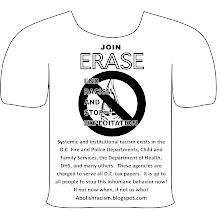
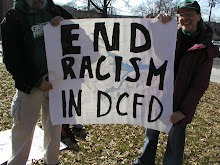
Please stay tuned. It was reported on ABC 7 that Captain Vanessa Coleman's case has been taken up by the Government Accountability Project, a law firm that protects whistleblowers. This means that the Mount Pleasant Fire will be fully investigated for the first time! The second thing of note is that it's been reported that a number of the young people who were fired from teh academy for allegedly not satisfying the academic side of the test, who had complained about unfair treatment and harassment, have been reinstated. Those interested, please contact us and you will be furnished with more information. E.R.A.S.E. sees these two aforementioned happenings as a s uccess... and to those who attempted to spam this blog with McCain McCain McCain, the Spook says Obama! Obama! Obama!! Racism in the DC Fire Department will be a thing of the past. This election has proven that people of all colors can come together for change, and recism will be identified as a thing of the past.
Bottom Line
Nothing Less